
Marketing Site
Public site with pricing, SEO structure and i18n, connected to the product catalog.
Three frontends, an API and billing through two providers: Stripe on your home account, Paddle as merchant of record everywhere else. The code is yours, no lock-in.
Built to be shipped with AI coding agents
Start with the parts that make your product unique. The rest is already built and running.
≈ 11 weeks of work before the first line of your product — or $147 and you start after that.
Three frontends, one API and the operational plumbing between them.
Public site with pricing, SEO structure and i18n, connected to the product catalog.
Authenticated customer area: dashboard, plan, usage and billing foundation.
Operate products, plans, features, users, subscriptions and PSPs.
.NET 10 API with EF Core, PostgreSQL and versioned endpoints.
Supabase-backed auth with sessions and protected routes across apps.
Products, plans and catalog managed from the admin panel.
Plans, feature flags and plan-feature bindings ready to model your offer.
Stripe and Paddle wired end to end: checkout, signed webhooks and entitlements, with checkout binding per plan.
Locale routing, translation files and language selectors in every frontend.
Vitest unit tests on the frontends, xUnit tests on the API and Playwright end-to-end suites.
Vercel-ready frontends and a containerized API you can deploy anywhere.
Branding, product, pricing and features driven by config files.
Domestic customers are charged through Stripe. Everyone else goes through Paddle as merchant of record, so VAT and sales tax are handled for you.
Every app has a single responsibility, and shared concerns live in one place.
apps/Three frontends with the same design language: marketing, customer app and admin.
backend/api/.NET 10 backend: products, plans, features, users, subscriptions and payment providers.
config/branding.json, product.json, pricing.json and features.json drive the whole product.
shared/ · docs/ · scripts/Conventions, documentation and automation shared by every project.
No exotic dependencies. Proven tools, typed end to end.
Branding, product, pricing and features are centralized configuration, not scattered constants.
One monorepo with frontends, API, database and scripts.
Colors, logo and themes in config/branding.json; name, slug and locales in config/product.json.
Model plans and features from the admin panel or config files.
Plug in Supabase credentials and your Stripe and Paddle keys. The integrations are already built.
Spend your time on the product, not on the boilerplate.
Ship to Vercel or any host you choose, with no lock-in.
{
  "primaryColor": "#7C4DFF",
  "secondaryColor": "#0D0D16",
  "logoText": "CastorStack",
  "themeModes": [
    "light",
    "dark",
    "system"
  ]
}Your purchase includes a 15-step onboarding trail in English, Spanish, and Portuguese. It takes you from an unopened package to a deployed product taking real payments. Every step ends with a verifiable check, written to be executed with an AI coding agent.
Different goals, same starting point.
Validate your idea with a real working product instead of a prototype.
Skip the plumbing and work on the features that set your product apart.
Deliver client SaaS projects with a professional baseline from day one.
Standardize how your team starts every SaaS engagement.
Launch internal tools with auth, admin and billing structure ready.
Reuse the same foundation across multiple products without re-learning it.
Grouped by the areas that matter when you're shipping.
Concrete defaults in the API and database — not a generic enterprise badge.
Stripe and Paddle use HMAC signature checks, constant-time comparison, a five-minute replay window, and idempotent event handling.
Every /api/v1/admin/* endpoint requires an authenticated admin session — verified route by route.
Payment provider secrets are encrypted with ASP.NET Data Protection, stored in the database, and never returned in plain text from the API.
Entity Framework Core is the only database access path — no string-built queries that open injection surfaces.
Supabase tables ship with row-level security and privilege hardening, with a regression test that fails the build if a table is left exposed.
Allowed origins are explicit and credentials are disabled — CSRF against cookie sessions is ruled out by configuration.
returnTo URLs must match configured allowed origins so checkout cannot become an open redirect.
Same design system, different jobs.

Sell the product: hero, pricing and SEO-ready pages.
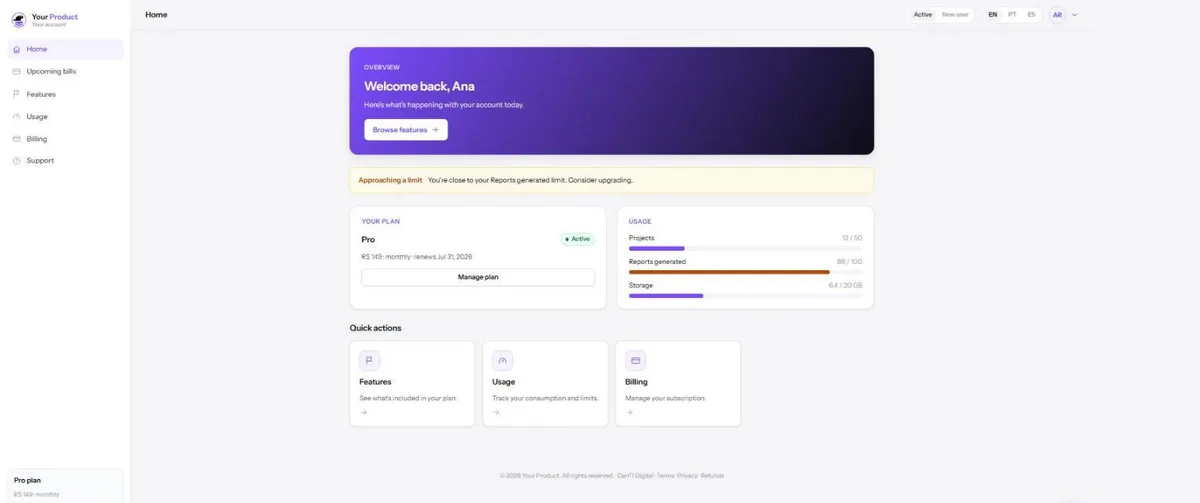
Simple, value-oriented area for the end customer.
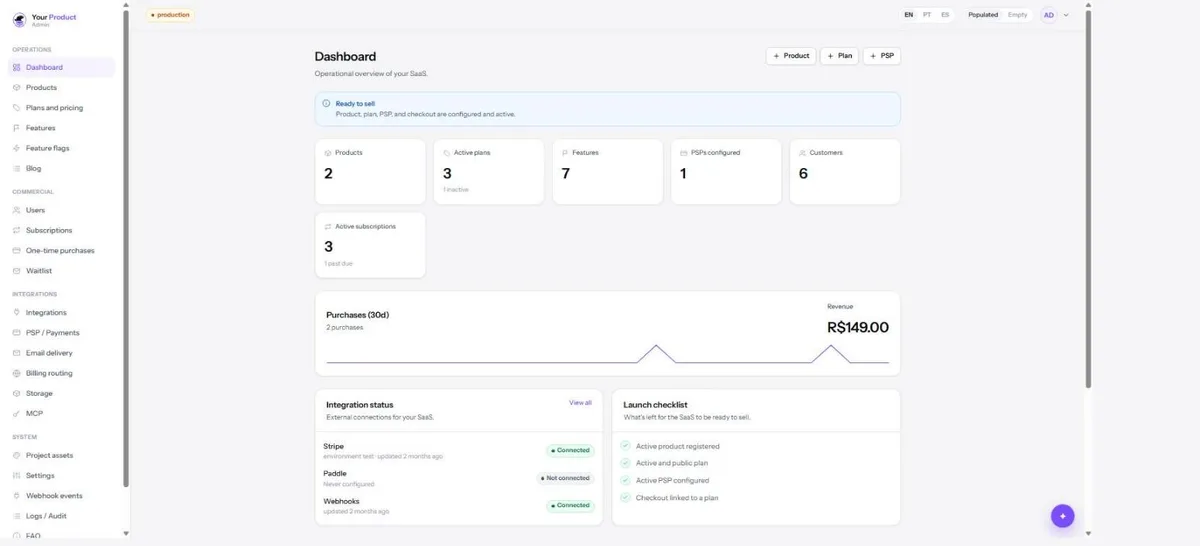
Dense, operational cockpit for the people running the SaaS.
Product identity and commercial rules live in versioned config files.
{
  "slug": "castorstack",
  "name": "CastorStack",
  "tagline": "A production-ready foundation to build and launch SaaS products.",
  "locales": [
    "en",
    "es",
    "pt"
  ],
  "defaultLocale": "en",
  "demoMode": true
}{
"currency": "USD",
"plans": [
{
"id": "starter",
"name": "Starter",
"priceMonthly": 0
},
{
"id": "growth",
"name": "Growth",
"priceMonthly": 199
}
]
}These samples are read from the real config/ files at build time. pricing.json is an install seed: after seeding, plans and prices live in the admin panel.

One of the founders of CastorStack and DanTI Digital, software engineer for 13+ years.
I built this template to ship SaaS products without rebuilding the foundation every time. It's the same code I use for my own products.
No. It's a code-first foundation for developers: a monorepo with React frontends, a .NET API and configuration files you own and extend.
AI agents are starting to research, choose, and even pay for digital products on behalf of users. Here's what agentic commerce means for how you design your pricing and signup flow.
A confirmation email that never arrives can cost you more users than any visible bug. Here's why email delivery got stricter in 2026, and what actually fixes it.
2026 research shows 43% to 61% of SaaS companies already running some hybrid pricing model. What changes once charging per seat stops being the default.
Get the codebase and spend your first week on what makes your product different.
One license, and the whole codebase is yours: authentication, global billing, admin tools and a .NET API, in code you own.
v1.20.0 · September 18, 2026 See what's new
All the source, yours forever. One payment, unlimited products.
What's included